
A signed offer does not constitute a completed hire; rather, it marks the beginning of the onboarding process.
Once a candidate accepts an offer, multiple steps are required before they receive their first accurate paycheck, particularly in countries where your organization lacks a local entity, payroll infrastructure, or HR presence. Effective Employer of Record (EOR) onboarding streamlines this process into a predictable timeline. Inadequate execution can result in delayed start dates, missed payroll deadlines, and a dissatisfied new hire before their first day.
This EOR onboarding checklist details the entire process, including the information your Employer of Record requires upfront, the ten steps from offer acceptance to first payroll, country-specific timeline variations, and common onboarding pitfalls. Use this document as a practical guide to structure your onboarding procedures.
Before the Offer: What Your EOR Needs From You
Efficient onboarding commences prior to the signing of the offer. The majority of delays originate from incomplete information at this stage, rather than from slow administrative processing later.
The efficiency of your EOR is contingent upon the completeness of the information you provide. Prepare the following three items in advance.
First, ensure the offer letter terms are compliant. Your EOR will use these to create a local contract, so details must be accurate: job title, start date, gross salary and currency, pay frequency, bonus or commission structure, working hours, leave, and any probation period. Unclear or incomplete terms are the leading cause of contract delays.
Second, determine the correct job classification. Specify whether the role is full-time or contractor, and identify the seniority and role category. Classification affects statutory benefits, tax treatment, and, in some countries, the legality of the arrangement. Incorrect classification can result in reclassification, back-pay, and penalties.
Third, gather the required documents for your EOR. While the list varies by country, you will typically need: the candidate’s identity document or passport, proof of address, tax identification number, bank details for salary, and, where applicable, work permit or visa status, educational or professional certificates, and emergency contact details.
Submit a comprehensive and accurate documentation package to your EOR on the first day to minimize obstacles throughout the onboarding process.
The 10-Step EOR Onboarding Flow
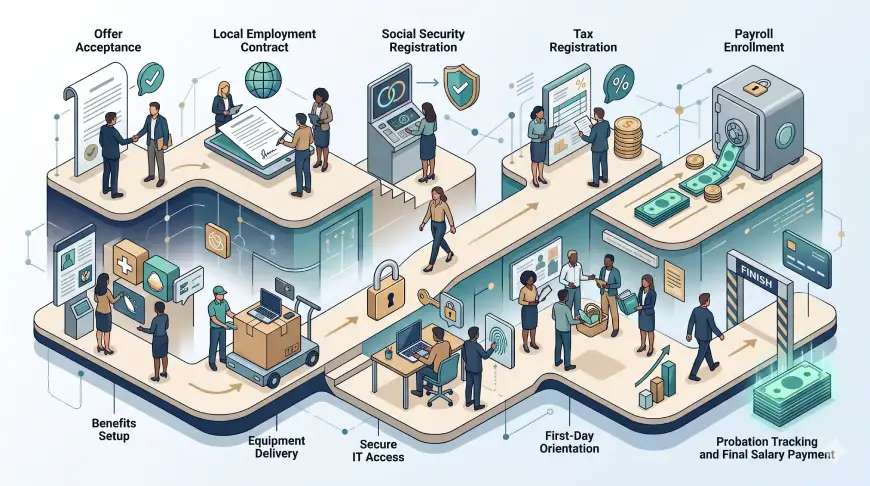
Outlined below is the complete EOR onboarding process, spanning from offer acceptance to the first payroll. Although the sequence may differ by country, these ten steps constitute the foundation of compliant onboarding.
Steps 1-3: Local Contract and Registrations
Step 1 — Issue the local employment contract. Your EOR drafts a contract compliant with the country’s labour law, often in both the local language and English. It includes offer terms and statutory requirements such as notice periods, leave entitlements, working hours, and mandatory clauses. The candidate reviews and signs the contract, establishing the legal basis for employment.
Step 2 — Complete social security registration. The EOR enrolls the new hire in the country’s statutory programs, including pension, health, unemployment, and any other required schemes. Social security registration is essential for legal employment and typically must be completed before the first payroll.
Step 3 — Complete the employee’s tax registration. The EOR secures or confirms the tax ID, sets the appropriate withholding category, and registers the employee with the relevant tax authority. Accurate tax registration ensures correct deductions and prevents future.
Step 4 — Payroll enrollment. The EOR enrols the employee in its payroll system, incorporating gross-to-net calculations, salary bank details, pay schedule, and any applicable allowances or deductions. Confirm the pay cycle and cutoff date at this stage, as these factors determine whether the first salary is paid on time. Accurate payroll enrollment is critical for a seamless initial payroll cycle.. Accurate payroll enrollment is essential for a smooth first cycle.
Step 5 — Benefits enrollment. The EOR enrols the employee in mandatory benefits and any supplemental benefits you provide, such as private health insurance, additional pension contributions, or meal and transport allowances. Decide on supplemental benefits in advance so they are included in the first payroll.
Step 6 — Equipment provisioning. For remote and distributed hires, timely equipment provisioning is essential. Order and ship laptops and other hardware in advance, accounting for customs and delivery times, which may extend to a week or more in certain countries. Ensure all equipment is prepared to provide a positive initial experience.
Step 7 — IT access and security setup. Set up accounts, tools, email, and system access, and complete all security and data-protection requirements. Coordinate with your internal IT team to ensure access is active on day one. Test credentials before the
Step 8 — Day one and orientation. The employee commences employment, acknowledges company policies, meets their manager and team, and becomes familiar with company operations. The EOR manages employment formalities, while your focus should be on welcoming the new hire and introducing their role. Prioritize building connections rather than administrative tasks on the first day. Prioritise connections over administration on the first day.
Step 9 — Probation tracking. Establish probation tracking at the outset. Record the probation period, review date, and evaluation criteria. Since probation rules and notice periods vary by country, schedule key dates immediately. Missing a probation deadline may result in unintended termination protections.
Step 10 — First payroll cycle and handover. The EOR processes the first payroll, calculates gross-to-net, applies deductions, and pays the salary in local currency. Review the first payslip with the employee, as errors often appear at this stage. Complete the onboarding handover so the new hire transitions from onboarding to ongoing management.
Country Differences That Change the Timeline
A smooth onboarding process may require two to five business days in some countries, while in others it may extend to several weeks. Although the procedural steps are consistent, the timeline varies by country. Three primary factors influence this duration.
Work permit and visa lead time. Onboarding is faster for local nationals. For foreign hires requiring sponsorship, work permit processing can add weeks or months. Always confirm work authorisation before setting a start date, as this is the most significant timeline factor.
Background check requirements. Some countries and roles require background checks before employment begins, while others limit what can be checked. Account for these requirements in your schedule to avoid delays during onboarding.
Registration and payroll schedules. Statutory registrations depend on local authorities’ timelines, and payroll operates on fixed monthly cutoff dates. Some countries also require a signed contract within days of employment. Missing a registration or cutoff can delay the first paycheck to the next cycle.
Recommendation: Request a country-specific onboarding timeline from your EOR at the offer stage, and establish the start date based on the longest dependency, which is typically the work permit process.
Common EOR Onboarding Mistakes (and How to Avoid Them)
Most onboarding mistakes in global hiring are common and avoidable, often repeated across different markets.
Setting a start date before confirming the timeline. Committing to a start date without verifying permits, registrations, and document collection often leads to delays. Solution: Set the start date only after your EOR confirms the country-specific timeline.
Missing the payroll cutoff. Each payroll has a strict deadline. Onboarding after the cutoff date delays the new hire’s first salary to the next month, creating a poor experience. Solution: Confirm the payroll cutoff before setting the start date and complete registrations in advance.
Misclassifying the role. Incorrectly classifying an employee as a contractor to save time or costs can result in reclassification, back taxes, and fines. Solution: Classify roles accurately at the offer stage and have your EOR confirm compliance with local regulations.
Submitting incomplete documents. Missing information, such as a tax ID or bank details, can halt the onboarding process. Solution: Use a document checklist and collect all required documents before starting.
Forgetting equipment and access. Delays in hardware delivery or account provisioning can negatively impact the first day. Solution: Order equipment and request access at least one week before the start date.
Treating onboarding solely as an administrative task. While compliance ensures accurate payment, it does not promote productivity or engagement. Solution: Integrate compliant onboarding with a meaningful employee experience, supported by a structured 30-60-90 plan.
Pairing EOR Onboarding with Your 30-60-90 Plan
Your EOR ensures that the new hire is legally employed and compensated accurately. Facilitating their effectiveness in the role is your responsibility, and a 30-60-90 onboarding plan serves as an effective tool for this objective.
Consider the process as two parallel tracks. The EOR track manages contracts, registrations, payroll, and benefits. The 30-60-90 track delineates the ramp-up: specifying what the new hire should learn, accomplish, and assume responsibility for during the first three months. The completion of the EOR handover at step ten marks the transition to the 30-60-90 plan.
A clear and structured approach is particularly effective for remote team onboarding, where informal knowledge transfer is not possible:
- First 30 days — learn. Context, tools, people, and processes. The goal is understanding, not output. Schedule deliberate introductions, since a remote hire won’t meet the team by accident.
- Days 31-60 — contribute. The new hire takes on real work with support, starts owning smaller deliverables, and builds working relationships across the team.
- Days 61-90 — own. They operate with autonomy, own outcomes, and align on longer-term goals. By day 90, you should both know whether the fit is right, which also aligns neatly with probation review.
A robust new-hire ramp-up transforms a compliant hire into a productive team member. The EOR eliminates legal and administrative barriers, while the 30-60-90 plan facilitates the transition from employee to active contributor. Both elements are essential. In one. You need both.
Onboard Faster with Gini Talent
Gini Talent integrates recruitment with comprehensive Employer of Record services, enabling both talent acquisition and compliant onboarding through a single partner. This integration significantly reduces the time between a signed offer and a productive first month.
When you onboard through Gini Talent, the ten steps above run as a single managed flow:
- Compliant local contracts, drafted to each country’s labour law and issued in the local language where required.
- All statutory registrations handled — social security, tax, and mandatory benefits — so the legal foundation is in place before the first payroll.
- Payroll that runs on time, with accurate gross-to-net calculation, correct deductions, and disbursement in local currency.
- A single point of accountability across the full employee lifecycle, from onboarding through ongoing administration to offboarding.
- Recruitment and EOR together, backed by Gini Talent’s Talent Score technology, so you can source and onboard from the same place.
The outcome is what every hiring manager seeks: a new colleague who is legally employed, accurately compensated, properly equipped, and prepared to contribute, all without the need to establish a local entity.