
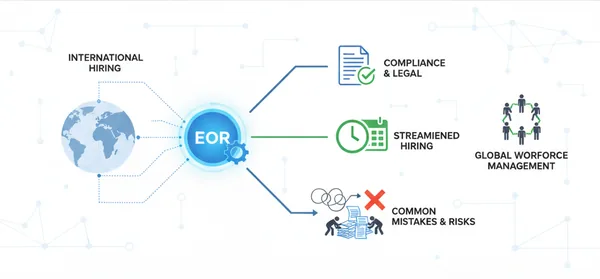
Global hiring is no longer limited to opening an entity in every country where you want to employ talent. An Employer of Record (EOR) is a solution that lets companies hire internationally while a local, compliant employer partner handles the formal employment relationship in the target country.
In this guide, you’ll get a practical, SEO-focused explanation of what is employer of record (eor)?, how it works, where it fits best, and how Gini Talent supports global expansion with less friction and more compliance confidence.
EOR meaning and core concept
When people ask what is an employer of record, the simplest definition is this: an EOR is a third-party organization that legally employs your worker on paper in a specific country, while the worker performs day-to-day tasks for your company. This model is designed for employer of record for international hiring, where local labor law, payroll, taxes, and mandatory benefits can get complex quickly.
So, what is employer of record (eor)? In practice, it’s a structure that separates “legal employment” from “operational management.” You still direct the employee’s work, performance, and goals, but the EOR manages the employment contract, statutory benefits, payroll processing, and local compliance duties on your behalf. This is especially valuable when you want to hire fast without creating a local subsidiary.
How an EOR works in global hiring (step-by-step)
An EOR arrangement usually follows a clean sequence. First, you choose the country and candidate, and the EOR confirms the legal hiring pathway. Then the EOR issues a compliant employment contract aligned with local regulations, registers the employee where required, and runs payroll each cycle with correct taxes and social contributions.
From your perspective, this becomes a predictable global hiring workflow: you approve salary and terms, the EOR executes the compliant employment process, and the employee works under your direction. This is the core of employer of record for international hiring—speed plus compliant administration, without needing your own local legal entity.
Why companies use an employer of record for international hiring
There are common reasons businesses choose an EOR instead of opening an entity. The top driver is speed: entity setup can take months, but EOR hiring can often be initiated much faster depending on the country and role. Another major driver is risk reduction—local employment law, termination rules, probation periods, and benefits expectations can be very country-specific.
Also, global expansion rarely happens in a straight line. Many teams want to validate a market before investing in a local entity. Using an EOR allows you to hire critical roles early, test demand, and build local presence with lower operational overhead—while remaining aligned with local labor requirements.
EOR vs. entity setup vs. contractors
When deciding between options, the main question is risk and control. Contractors can be faster, but misclassification is a serious issue in many countries—especially if the role looks like full-time employment. Entity setup offers maximum internal control, but it’s slower and usually demands local accounting, legal, and ongoing compliance management.
An EOR sits in the middle. It’s often the best fit when you want full-time, long-term team members abroad without the timeline and cost of establishing a subsidiary. In other words, it’s a practical model for scaling global teams with lower friction.
EOR compliance, payroll, and legal responsibilities
A common misunderstanding is assuming an EOR removes all compliance responsibilities. The EOR takes on key legal employer obligations in the country—contract compliance, payroll processing, tax withholding, and statutory benefits administration. However, your company still must follow correct operational practices: role scope, working hours expectations, and workplace policies should align with local standards.
This is why eor compliance and legal risks should be treated as a shared responsibility model. A strong EOR helps reduce risk by applying local expertise, but your internal process still matters—especially around documentation, approvals, and consistent HR practices across countries.
Local labor law and statutory benefits
Statutory benefits (like required leave, social security contributions, and mandatory insurance) vary widely. An EOR helps you align employment terms with local requirements so you don’t unintentionally under-provide benefits or structure compensation in a non-compliant way.
This becomes particularly important in countries with strict termination rules or employee protections. Getting contract clauses, probation periods, and notice requirements correct from day one is a major reason companies prefer an EOR for international expansion.
Data privacy and employment documentation
Global hiring also involves employee data: identity documents, bank details, addresses, and tax numbers. A reliable EOR should support secure documentation flows and clear data handling processes—especially for multi-country workforces.
If your team uses HR tools, onboarding platforms, or time tracking systems, it’s smart to confirm what data will be shared and how it’s stored. This is part of preventing downstream compliance headaches as you scale.
Global workforce management using EOR
Beyond hiring, companies often underestimate the operational value of EOR in day-to-day international employment. Global workforce management using eor includes handling local payroll calendars, mandatory filings, benefits enrollments, and changes such as salary adjustments or promotions.
This matters because global teams don’t operate on one universal HR rulebook. When you expand into multiple countries, your HR operations can easily become fragmented. An EOR model brings structure—so you can centralize your decisions while local compliance execution stays consistent.
How EOR services support HR operations at scale
As headcount grows across countries, simple tasks become complicated: onboarding timelines differ, payroll cutoffs vary, and local holidays affect start dates. With an EOR, these country-specific rules are handled within a standardized process.
That operational consistency is exactly how eor services streamline hiring and ongoing administration. You reduce internal coordination overhead while staying closer to local compliance expectations.
Building a compliant onboarding workflow
A scalable onboarding process should include: country-specific contract issuance, document collection, benefits enrollment, and a clear start-date plan aligned with payroll cycles. Even a one-week delay can push the employee into the next payroll period, causing avoidable frustration.
With an EOR, onboarding can be structured like a repeatable playbook per country—so your hiring managers can focus on training and performance, not paperwork and legal steps.
How EOR services streamline hiring
Let’s get specific about how eor services streamline hiring. Instead of creating local legal infrastructure, you leverage the EOR’s existing framework: local registration, payroll, benefits providers, and compliance procedures are already in place.
This is especially useful for teams hiring internationally for the first time. It turns global hiring into a controlled process: choose country → confirm compliant employment path → sign contract → start work. That repeatability is why EOR is widely used for multi-country scaling.
Faster time-to-hire for international roles
Time-to-hire often improves because you remove the entity setup stage and reduce legal back-and-forth. You still need role clarity and compensation alignment, but the “employment mechanics” become smoother.
If your business is racing to fill critical roles (sales, engineering, customer success), EOR can help you start building faster—without waiting for incorporation timelines.
Reducing operational load on internal teams
Internal teams usually feel the pain first: finance struggles with multi-currency payroll, HR struggles with country rules, and legal gets stuck reviewing contracts for every new region. EOR redistributes that workload so global hiring doesn’t overload your core functions.
This is one of the most practical reasons companies adopt EOR early—especially startups and scaleups expanding across multiple markets.
Practical examples and best practices
Understanding what is an employer of record becomes easier with real scenarios. Imagine you want to hire a developer in Poland, a sales rep in the UK, and a customer support agent in Mexico. Each location has different employment rules, payroll requirements, and benefits norms.
With an EOR, you can hire across those countries using a similar workflow, while the local details are handled correctly. That’s a best-practice approach for international growth: standardize your internal approvals, and let local experts execute compliant employment.
Example 1: Hiring one employee in a new country
If you’re hiring your first person in a new country, entity setup is often too heavy. EOR is typically the best-fit model because it reduces setup complexity while keeping the worker in a compliant employment relationship.
Best practice: define a “country launch checklist” (salary band, benefits expectations, working hours, equipment policy), then run the hire through the EOR process.
Example 2: Scaling a multi-country team
Once you scale beyond 5–10 international employees, the risk is inconsistency—different contract templates, different onboarding checklists, and fragmented payroll calendars. EOR can help you keep hiring consistent, especially when you expand rapidly into new markets.
Best practice: centralize approvals (comp, role, start date) and track everything in one internal system, while the EOR manages country compliance execution.
Best practices for choosing an EOR partner
A strong EOR partner should offer transparent fee structures, clear country coverage, reliable support response times, and documented compliance processes. You should also assess their payroll accuracy track record and how they handle changes (promotions, salary updates, terminations).
For additional guidance on compliant international employment, you can reference the International Labour Organization (ILO) resources as a reputable external source for labor-related context.
Common mistakes to avoid
Even though EOR simplifies global hiring, mistakes still happen—usually because teams treat EOR as a “set-and-forget” solution. The most common failures relate to unclear role definitions, inconsistent approvals, and not understanding the boundaries of who is responsible for what.
This section addresses challenges of using an employer of record services in the real world—and how to avoid them before they become expensive problems.
Mistake 1: Treating EOR like a contractor workaround
Some companies try to use contractors to move faster, then switch later. But misclassification risks can be serious and costly. If the worker operates like an employee, many countries expect an employment relationship.
Using an EOR from the start is often safer when you need full-time, ongoing roles. It’s a direct way to reduce classification ambiguity and build a compliant structure early.
Mistake 2: Misunderstanding EOR compliance and legal risks
EOR compliance and legal risks often show up at the worst moment—termination, disputes, or audits. If your internal documentation is weak or approvals aren’t recorded, even a good EOR can’t fix gaps in your decision trail.
Best practice: maintain written approvals for compensation, job scope, and any material changes. Treat international hiring like a process, not a one-off event.
Mistake 3: Inconsistent compensation and benefits expectations
Offering a package that doesn’t match local expectations can hurt retention fast. Some markets prioritize private health coverage, others value allowances, and some have strong statutory benefits that change the “net feel” of compensation.
Work with your EOR to align salary bands and benefits to local norms. This prevents hiring friction and avoids unpleasant surprises after onboarding.
Mistake 4: Ignoring onboarding and performance setup
Global hiring isn’t only legal—it’s operational. Many international hires fail because onboarding is weak: unclear goals, no training, poor equipment planning, and time zone confusion.
Best practice: run the same onboarding rigor you apply locally, but adjust for location. That’s how you turn EOR hiring into a long-term performance win.
When an Employer of Record is the right choice
EOR is a strong fit when you want to hire internationally without entity setup, when you need full-time employees (not contractors), and when compliance confidence matters more than building local infrastructure immediately. It’s also useful for testing new markets before committing to incorporation.
If you’re planning global expansion, the fastest path is usually a phased approach: start with EOR, validate the market, then decide whether entity setup is worth it for your long-term strategy.
Conclusion
So, what is employer of record (eor)? It’s a structured way to hire internationally through a compliant local employer partner—without building your own entity in every country. For teams scaling across borders, EOR reduces operational friction, improves speed, and helps manage country-specific employment requirements.
If your goal is sustainable global growth, treat EOR as a repeatable hiring system: clear internal approvals, strong onboarding, and ongoing compliance discipline. That’s how you get the benefits of global expansion—without the headaches.


