Shifts in global trade are pushing businesses to engage talent across borders. Outsourcing and nearshoring are two strategies to manage costs while maintaining service levels. Each offers distinct benefits and challenges. Deciding between them involves weighing cost reductions against localized service and operational nuances. Nearshoring vs outsourcing? There’s more to it than just cost and expense.
Nearshoring vs Outsourcing
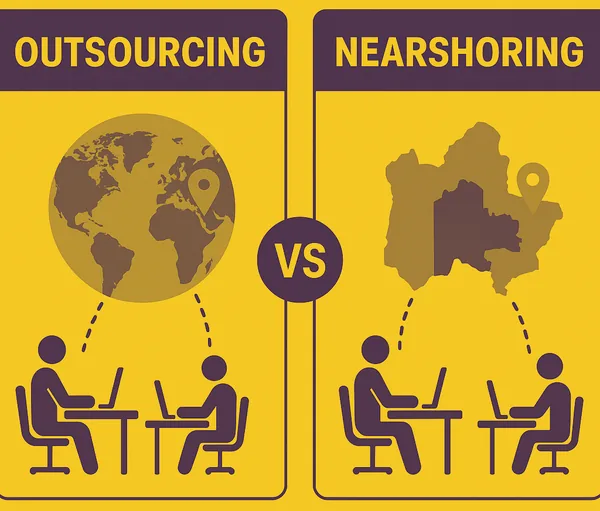
Both outsourcing and nearshoring involve delegating or relocating business operations to external entities, but their geographic focus and strategic implications differ.
Outsourcing is when businesses contract some of their work to third-party vendors, often in distant or low-cost regions. Companies outsource to reduce expenses, access specialized skills, and focus on core activities. It can be done domestically or internationally and typically emphasizes cost savings through external labor and services.
Nearshoring, a form of international outsourcing, relocates operations to a country in close geographic proximity. Examples include a U.S. company nearshoring to Mexico or Colombia or a German company moving some operations to Poland. Nearshoring emphasizes physical closeness and shared time zones. Like outsourcing, it aims to reduce costs and tap into skilled talent pools with lower salary requirements, but its proximity offers operational advantages beyond just pricing.
Outsourcing: Pros & Cons
Outsourcing can occur in a variety of ways. It can be off-site, offshore, or hybrid. Regardless of which form it takes, outsourcing offers significant strategic benefits but comes with trade-offs.
Pros of Outsourcing
- Cost Savings: Outsourcing is traditionally attractive because it offers substantial financial advantages, often reducing operational costs when compared to in-house functions. Companies benefit from lower wage structures in foreign markets or specialized vendor networks.
- Access to Global Talent: Outsourcing makes it so that businesses can access specialized, global expertise. In sectors like IT, this is essential given the global deficit of 4.3 million software developers.
- Scalability: With lower operating costs and cheaper labor, companies that outsource are better positioned for rapid expansion or contraction based on demand. Many businesses scale faster through outsourcing than via traditional hiring.
- 24/7 Operations: Outsourcing to vendors in distant time zones allows for continuous workflow and round-the-clock support or development cycles.
- Higher ROI: Well-scoped, repeatable projects often achieve higher return on investment when outsourced to experienced vendors.
Cons of Outsourcing
- Delays & Barriers: When vendors are in far-off regions, large time differences and inconsistent communication practices can slow progress. Similarly, working across cultures can lead to miscommunication, differing expectations, and workstyle clashes.
- Intellectual Property (IP) Concerns: Sharing sensitive data across borders and with third-party contractors raises the risk of data breaches, IP theft, or the exposure of proprietary products. Strong legal protections and oversight are essential.
- Regulatory Issues: Navigating international labor laws, tax codes, and data protection regulations can be complex, especially when multiple countries are involved.
- Hidden Costs: Training, currency volatility, legal compliance, logistics, and travel for oversight can reduce initial cost benefits.
- Loss of Direct Control: Delegating work to external vendors can limit visibility, making real-time supervision or adjustment difficult, especially in agile environments.
- Supply Chain Vulnerabilities: As seen during the COVID-19 pandemic, outsourced operations are particularly susceptible to geopolitical disruptions or crises.
- Reputational & Social Risks: Outsourcing often triggers public resentment in the company’s home country over job losses. Unethical practices, such as poor working conditions in the outsourced country, can also cause reputational harm in all countries of operation.
Nearshoring: Pros & Cons
Nearshoring delivers many of the benefits of outsourcing while also offering benefits that can reduce risk and increase efficiency.
Pros of Nearshoring
- Cost Savings: While nearshoring labor costs may be higher than in distant outsourcing regions, the total cost often drops due to improved productivity and lower risk. Nearshoring operations are also typically lower cost than domestic ones.
- Improved Communication: Shared time zones enable real-time dialogue, quicker decisions, and higher responsiveness. Nearshore teams report fewer delays and better communication within two-hour windows. Greater cultural similarity enhances understanding and lowers the chance of miscommunication.
- Skilled Regional Talent: Nearshoring taps into quality talent pools that can more easily align with internal teams.
- Agility & Resilience: Shorter supply chains, regional proximity, and faster delivery reduce vulnerability and improve agility. Nearshore projects often report faster time-to-market.
- Simplified Oversight & Compliance: Proximity allows for more site visits, easier legal alignment, and smoother regulatory compliance. This is particularly helpful when operating within trade agreements or regional blocs.
Cons of Nearshoring
- Higher Costs than Distant Outsourcing: Though cheaper than domestic operations, nearshoring usually costs more than outsourcing to farther, low-cost regions.
- Regional Instability Risks: Political or economic volatility in nearby countries can have a stronger impact on operations due to geographic and economic ties. Unlike with distant outsourcing, domestic instability can also affect nearshored operations
- Legal & Regulatory Variance: Even among neighbors, differences in labor laws, IP protection, and worker rights exist. Reputational damage from violations may carry more weight due to cultural familiarity.
- Talent & Infrastructure Variance: While qualified, nearshore talent pools may lack the depth or specialization found globally. Some nearshore locations may have underdeveloped digital or physical infrastructure, impacting service quality.
How to Choose: A Strategic Framework
Selecting the right strategy involves more than choosing the lowest bidder. The best fit depends on operational needs, risk tolerance, and long-term goals.
- Clarify Strategic Priorities: Is your top goal cutting costs, improving agility, gaining specific expertise, or enabling real-time collaboration?
- Evaluate Project Complexity: Agile, collaborative tasks (like product development or customer support) may benefit from nearshoring’s time zone alignment. Highly repeatable, low-touch processes (like data entry or QA) can be more cost-effectively outsourced farther away.
- Consider Talent Requirements: Outsourcing gives access to massive global talent, especially for niche skills. Nearshoring offers closer integration and faster onboarding for roles needing strong communication.
- Assess Risk Appetite: Are you prepared to manage risks like data breaches, regulatory issues, or geopolitical instability? Nearshoring generally reduces exposure to these threats.
- Balance Short- and Long-term Needs: Long-term outsourcing partnerships can offer consistent cost savings, while nearshoring is ideal for fast ramp-ups and shorter project cycles.
- Review Compliance Complexity: In regulated sectors like healthcare or finance, nearshoring simplifies audits, compliance checks, and contract enforcement.
- Prioritize Speed and Flexibility: For startups or time-sensitive launches, nearshoring offers shorter turnaround times and greater ability to pivot.
Conclusion:
It’s no longer enough to chase the lowest possible cost. While traditional outsourcing offers broad reach and significant cost savings, nearshoring delivers a compelling blend of cost efficiency, collaboration, and resilience. Ultimately, the choice between nearshoring and outsourcing is not one-size-fits-all. Both remain viable, valuable strategies – each suited to specific operational goals, project needs, and market realities.
As recent disruptions have ramped up interest in regionalization, business leaders must rethink operational models. While it’s tempting to only consider bottom lines and profit margins, operational agility and risk appetites can be just as impactful for financial success.
Outsourcing and nearshoring both create opportunities and risks, but engaging the right workforce for the right tasks requires companies to understand their own needs as well as the regions and external partners that can help meet them.
Gini Talent – A Strategic Imperative
Gini Talent helps you choose the right hiring model — nearshore or offshore — based on your goals, budget, and timeline.