
EU Pay Transparency Directive takes full effect in June 2026, and “Salary: Competitive” is no longer a valid answer. Here is everything you need to know before the rules change.
There is a two-word phrase that has wasted millions of hours for candidates, driven top talent away from thousands of companies, and contributed to pay gaps that last for decades.
That phrase is: Salary: Competitive.
It means nothing. Starting June 7, 2026, it will be effectively illegal across the European Union.
The EU Pay Transparency Directive, formally Directive (EU) 2023/970, represents one of the biggest changes in labor market regulation in a generation. It does not just encourage companies to be open; it makes it a requirement, with real penalties for those that do not comply. For candidates looking for jobs in Europe and for companies aiming to attract global talent, understanding this is no longer optional.
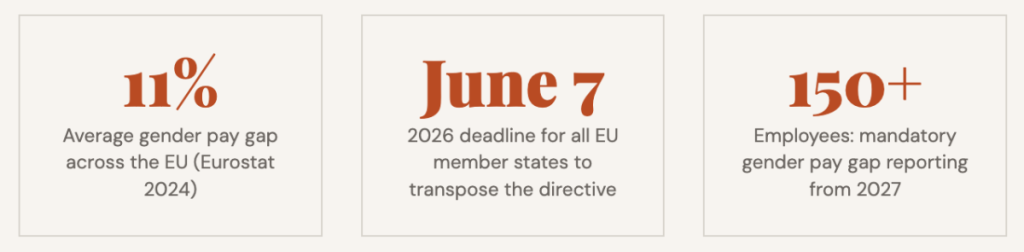
What the Directive Actually Requires The directive was adopted in June 2023. Member states have until 7 June 2026 to incorporate it into their national law. It applies to all employers, both public and private, that operate within EU member states, including non-EU companies that employ people in Europe.
Key Requirements at a Glance
→Salary ranges in job postings. Employers must disclose the initial pay or pay range for advertised roles — either in the job ad itself or, at the latest, before the interview begins. Vague language like “competitive” or “market rate” does not comply.
→Salary history ban. Employers cannot ask candidates what they currently earn or earned at a previous job. The question is prohibited at any stage of the hiring process.
→Employee right to information. Workers can request — in writing — their own pay level and the average pay levels of colleagues doing comparable work. Employers must respond within two months.
→Pay gap reporting. Companies with 150 or more employees must publish gender pay gap data annually starting in 2027, using 2026 compensation data. A gap exceeding 5% that cannot be justified on objective grounds triggers a mandatory joint pay assessment.
→Reversed burden of proof. In pay discrimination cases, the employer — not the employee — must prove that no discrimination occurred.
Several member states are going further than the EU minimum. Ireland and the Netherlands are moving toward requiring salary ranges to appear in every job advertisement. Spain already requires a full pay register for all employers. Slovakia’s implementation, expected in force from June 2026, requires pay ranges to be shared before any compensation negotiations commence.
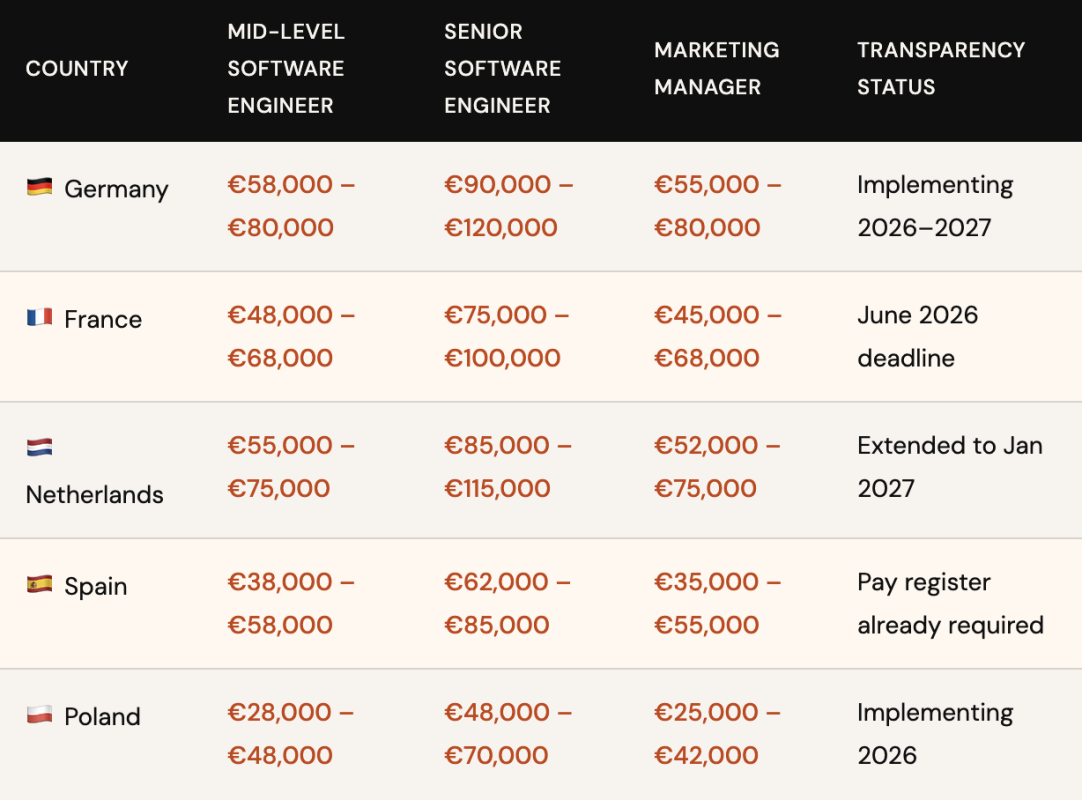
What This Looks Like Country by Country
For anyone considering a move to Europe — or hiring talent across European markets — understanding real salary benchmarks is now essential context. The following data reflects median gross annual compensation across major European markets for mid-level professional roles in technology and business.
“The salary history question — ‘what do you currently earn?’ — is how underpaid candidates stay underpaid. The directive breaks this cycle by making the question illegal.”
For Candidates: How to Use Transparency to Negotiate Better
The directive shifts power significantly toward candidates. But knowing the law exists and knowing how to use it are different things. Here is how to act on it.
Know your number before the conversation starts
With salary ranges now required before interviews, you will often enter the conversation already knowing the range. Do not anchor yourself to the bottom of it. Research what the median looks like for your experience and skills — platforms like Glassdoor, Levels.fyi, and Ravio’s compensation reports give you that data. Come in with a specific number, not a range of your own.
Understand what “total compensation” means
Base salary is only part of the picture. In Germany, tech companies increasingly offer significant equity; in France, the 13th-month pay is standard in many sectors; in the Netherlands, holiday allowance (typically 8% of gross annual salary) is legally required. Always ask for the total compensation package, not just the base.
Use your right to information
Once employed, you now have a legal right to request information about the average pay of colleagues doing comparable work. This is not a confrontational act — it is a legal right. Use it to understand whether your compensation is fair and to inform future negotiations.
If a company still asks your salary history, that is a signal
After June 2026, asking about salary history is illegal in EU member states. If a recruiter or hiring manager asks anyway, that tells you something meaningful about how this organisation approaches compliance, fairness, and candidate experience. It is worth noting.
For Companies: Why Transparency Is a Competitive Advantage, Not a Burden
Many employers have resisted salary transparency out of fear — fear of internal unrest, of inflexibility, of showing their hand in negotiations. The data suggests this resistance is misplaced and, after June 2026, moot.
You will attract more candidates
Companies that post salary ranges receive substantially more qualified applications than those that do not. Candidates filter themselves in and out based on the range, meaning the applications you receive are more likely to be serious fits. The recruitment process becomes faster and more efficient — not slower.
You will retain better employees
Pay opacity breeds resentment. When employees discover — as they inevitably do — that a colleague in a similar role is earning significantly more, the damage to morale and retention is severe. Proactive transparency, built around clear, defensible pay structures, addresses this before it becomes a problem.
The compliance cost of not acting is higher than acting
The directive introduces real penalties for violations. Perhaps more significantly, the reversed burden of proof means that if a pay discrimination claim arises, your organisation must be able to demonstrate objective, documented reasons for pay differences. Companies that wait until they receive a claim to organise their pay data will be at a serious disadvantage.
| Audit your pay structure now Map roles to compensation bands based on objective criteria: skills, responsibilities, impact. Document the methodology. This becomes your legal foundation for any future pay queries. | Rewrite your job postings Remove “Salary: Competitive.” Replace it with a realistic, honest range. Make the range narrow enough to be meaningful — posting €40,000–€120,000 covers all bases but satisfies no one. |
| Train your recruiters Salary history is off the table. Recruiters need new scripts and new habits. “What are your salary expectations for this role?” is the replacement — a small change with significant implications. | Prepare for pay gap reporting If you have 150 or more employees, your 2026 pay data will form the basis of your first mandatory report in 2027. Start collecting and cleaning that data now, not when the deadline arrives. |
The Bigger Picture
Salary transparency is not only a European regulatory trend. It reflects a fundamental shift in the relationship between employer and candidate — one accelerated by the internet, by platforms that aggregate salary data, and by a generation of workers who simply do not accept opacity as a norm.
The companies that adapt earliest — that build clear, fair, publicly defensible pay structures and talk about them openly — will find the directive creates a genuine competitive advantage in the war for global talent. The companies that treat compliance as a box-ticking exercise will find they have done the work and captured none of the benefit.
The era of “Salary: Competitive” is over. The question is which side of this shift you want to be on.
Navigating the European job market?
Gini Talent connects candidates with transparent, fairly compensated roles across Europe — and helps companies build hiring processes that attract the best global talent.
Get in touch with Gini Talent!