
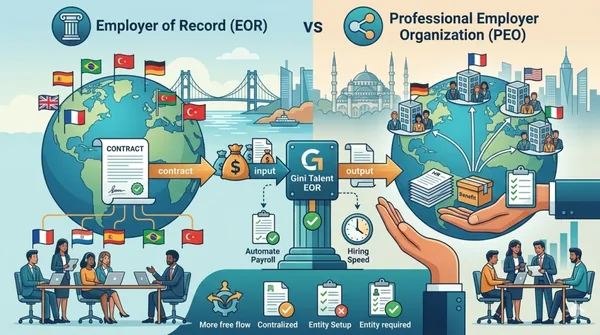
Companies expanding into new markets often come across two similar workforce solutions: Employer of Record (EOR) and Professional Employer Organization (PEO). At first glance, both models seem to offer similar support in payroll, HR administration, and employment compliance, which is why many companies confuse them during the early stages of expansion planning.
However, the difference between EOR and PEO is much more than a matter of terminology. The legal structure behind each model affects how a company hires, whether a local entity is required, and how quickly a business can enter a new market. Understanding this distinction is essential for any company that wants to build an international workforce with the right operational and compliance model.
What Is the Difference Between EOR and PEO?
The difference between an Employer of Record and a PEO begins with the legal employment structure. An EOR becomes the legal employer of the worker on behalf of the client company, while a PEO works alongside a company that already has a legal entity and shares certain HR responsibilities under a co-employment arrangement.
This distinction shapes how each model is used in practice. An EOR is typically chosen when a company wants to hire internationally without setting up a local legal entity, while a PEO is generally used by companies that are already established in a country and need support with HR administration, payroll processes, and employee benefits.
Why This Difference Matters for International Hiring
When companies hire across borders, legal employer status becomes one of the most important factors in the employment model. If a business does not have a registered entity in the target country, it usually cannot hire employees directly in a compliant way. In this case, an Employer of Record provides the legal infrastructure needed to employ talent quickly and lawfully.
A PEO, on the other hand, does not eliminate the need for a local entity in most cases. Because the client company remains the legal employer, the business must already be established in the country where it wants to hire. This is why companies evaluating EOR vs PEO for international hiring often find that the right answer depends first on entity ownership and only then on HR support needs.
What Is an Employer of Record (EOR)?
An Employer of Record is a third-party organization that legally employs workers on behalf of another company. In this arrangement, the EOR becomes the formal employer responsible for employment contracts, payroll, statutory benefits, tax withholding, social security contributions, and ongoing labor law compliance in the employee’s country.
At the same time, the client company continues to manage the employee’s daily work, reporting lines, responsibilities, and performance expectations. This structure makes EOR services especially valuable for international businesses that want to hire employees in new countries without opening a subsidiary or building local HR and payroll infrastructure from scratch.
What Is a Professional Employer Organization (PEO)?
A Professional Employer Organization is an HR service provider that supports companies through a co-employment model. Under this structure, the client company remains the legal employer, while the PEO helps manage selected HR functions such as payroll administration, benefits coordination, compliance support, and internal HR processes.
Because of this structure, a PEO is generally better suited for businesses that already operate locally and need administrative support rather than full employment outsourcing. In other words, a PEO strengthens HR operations for an existing local business presence, while an EOR helps companies hire where they do not yet have one.
The Core Structural Difference Between EOR and PEO
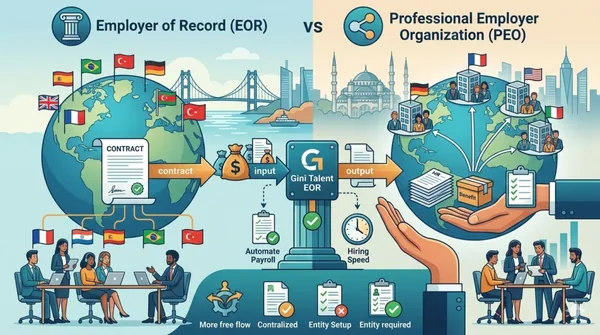
The most important difference between EOR and PEO is who acts as the legal employer. In an EOR model, the provider is the legal employer, which means the EOR takes responsibility for formal employment obligations and enables hiring without a local entity. In a PEO model, the client company remains the legal employer and therefore must already be legally established in the country.
This structural difference directly affects hiring flexibility, expansion speed, and compliance exposure. Companies entering new countries, testing a market, or building distributed teams often prefer EOR because it removes entity barriers. Companies that already have a registered presence and only need HR support may find PEO more appropriate for their operating model.
How an EOR Works in Practice
An EOR workflow usually starts when the client company selects the candidate it wants to hire. The EOR then prepares a locally compliant employment contract, ensures the worker is registered correctly, and manages onboarding from a legal and administrative perspective so the employee can start work in accordance with local regulations.
After onboarding, the EOR continues to handle payroll, tax withholding, social contributions, statutory reporting, and other employment obligations. Meanwhile, the client company remains fully responsible for the employee’s day-to-day work, deliverables, and integration into the wider team. This creates a clear separation between legal employment management and operational people management.
How a PEO Works in Practice
A PEO model works differently because it starts with the company already having a local entity. Employees are hired under the client company’s own legal structure, and the company then partners with the PEO to support HR administration, payroll coordination, employee benefits, and selected compliance-related functions.
Although the PEO may play a major role in administration, the client company still carries primary legal responsibility as the employer. This means the company remains responsible for the broader employment framework in the country, which is why a PEO is generally seen as an HR outsourcing solution rather than a market-entry hiring solution.
EOR vs PEO in Terms of Compliance
Compliance is one of the biggest reasons companies compare EOR and PEO models before expanding internationally. Employment regulations vary from country to country, and mistakes in contracts, tax withholding, social security payments, benefits, or termination procedures can create financial penalties and legal risk.
An EOR usually takes on a broader compliance role because it is the legal employer of record. A PEO may support compliance processes, but since the client company remains the employer, responsibility is more shared. This difference becomes especially important when hiring in jurisdictions with complex labor laws, strict termination rules, or detailed payroll reporting requirements.
Employment Contracts, Payroll, and Legal Responsibility
Every compliant employment relationship depends on correct contracts, accurate payroll, and proper handling of statutory obligations. In an EOR model, these elements are typically managed by the provider, which reduces administrative pressure on the client company and provides a more streamlined route to hiring in foreign markets.
In a PEO model, payroll and HR administration may also be supported, but the legal employment relationship remains tied to the company’s own entity. As a result, the business must still ensure that the underlying local setup is already in place. This is why companies comparing EOR vs PEO should look beyond payroll support and focus on where legal responsibility actually sits.
Cost Differences Between EOR and PEO
EOR and PEO pricing models often look different because the scope of responsibility is different. EOR providers typically charge a fixed monthly fee per employee, which usually covers employment administration, payroll processing, compliance management, and local statutory requirements under one service structure.
PEO providers often price their services as a percentage of payroll or as an HR administration fee, depending on the services included. However, when comparing costs, companies should also consider indirect expenses such as local entity setup, legal registration, accounting infrastructure, and time-to-hire delays. In many international hiring scenarios, those hidden costs make EOR the more efficient option.
When EOR Is Usually the Better Choice
An Employer of Record is usually the better fit when a company wants to hire in a new country without opening a legal entity. It is especially useful for market entry, remote hiring, early-stage expansion, and distributed team building where speed and compliance are both critical.
EOR also makes sense for companies testing a market with a small number of employees before deciding whether to establish a permanent presence. Instead of investing heavily in entity formation too early, businesses can use an EOR to start operations quickly and evaluate long-term expansion with much less risk and complexity.
When PEO Is Usually the Better Choice
A PEO is usually the better solution when a company already has a registered entity and wants support with ongoing HR administration. In that context, the business does not need a third party to act as the legal employer, but it may still benefit from help with payroll coordination, employee benefits, and internal HR processes.
This makes PEO more suitable for companies that are focused on improving administrative efficiency within an existing domestic structure. Rather than solving international hiring barriers, a PEO helps organizations strengthen HR operations where they are already legally established and actively employing staff through their own entity.
Common Misunderstandings About EOR and PEO
One common misunderstanding is the belief that a PEO can replace the need for local entity setup. In reality, most PEO models do not solve that problem because the client company generally remains the legal employer. Without a local legal entity, a PEO is usually not the right structure for compliant hiring.
Another frequent misconception is that using an EOR means outsourcing employee management entirely. That is not the case. The client company still directs the employee’s daily work, defines goals, manages performance, and integrates the person into its team. The EOR handles legal employment responsibilities, but the employee remains operationally aligned with the client company.
How to Decide Between EOR and PEO
The easiest way to decide between EOR and PEO is to start with one question: does your company already have a legal entity in the country where you want to hire? If the answer is no, an EOR is usually the more practical and compliant route. If the answer is yes, then a PEO may be a useful option if your main need is HR support rather than legal employment infrastructure.
The second factor is speed. If your company needs to hire quickly, test a new market, or expand across multiple countries without building local entities one by one, EOR is generally the stronger model. If your company is focused on optimizing HR administration in a country where you already operate, PEO may be the more natural fit.
EOR vs PEO for Hiring in Turkey
For companies hiring in Turkey, the distinction between EOR and PEO is especially important because employment regulations involve payroll tax withholding, social security contributions, employment contracts, notice periods, and severance-related obligations. Compliance requires local expertise and accurate administrative execution from the beginning of the employment relationship.
If your company does not have a Turkish legal entity, an Employer of Record is often the most practical route to compliant hiring. It allows you to hire employees in Turkey without opening a company, while ensuring that payroll, statutory registrations, and labor law requirements are handled properly. You can also connect this article internally to your Turkey EOR page to support conversion and topic relevance.
Why Companies Choose Gini Talent for EOR Services
At Gini Talent, we help international companies hire employees in new markets with speed, clarity, and compliance. Our Employer of Record solutions are designed for businesses that want to expand without the delay and complexity of local entity setup, while still maintaining full control over team management and business outcomes.
We support global hiring strategies by combining local employment expertise with practical onboarding, payroll, and compliance operations. For companies evaluating EOR vs PEO, we help identify the right model based on hiring geography, legal structure, operational needs, and long-term expansion goals.
Talk to Our EOR Team
Choosing between EOR and PEO is ultimately a strategic decision that depends on how and where your company plans to grow. The right model can reduce risk, improve hiring speed, and create a smoother path for building teams in new markets.
If you are evaluating international hiring options, Gini Talent can help you understand which model fits your expansion strategy best. Talk to our EOR team to explore your options and build your global workforce with the right structure in place.