
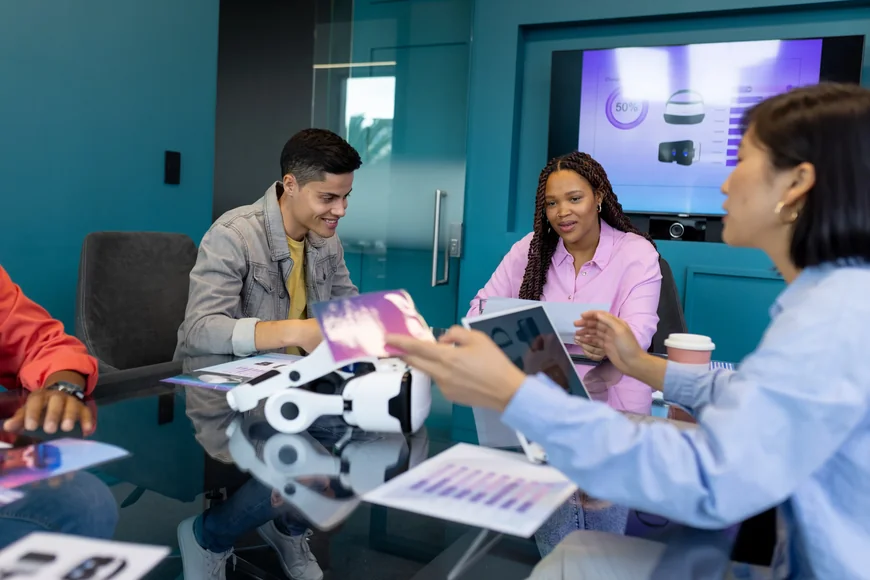
Global workforce trends in 2025 highlight the end of trial and error in casual hybrid schedules. Leading companies now adopt structured hybrid models with clear rules and objectives. In this model, offices serve as collaboration hubs for workshops, onboarding, and culture-building. Remote days are reserved for deep focus work. This balance makes both environments more effective.
One challenge in the global workforce trends 2025 is proximity bias. Managers may unconsciously favor employees who are physically present in the office. Training managers to measure performance based on results and outcomes is critical to ensure fairness.
Proximity bias – the tendency for managers to favor employees who are physically present.
Research from organizations like Gartner, Microsoft, and McKinsey confirms that employees working remotely are often overlooked for promotions, feedback, or stretch assignments compared to those in the office.
As companies adopt more flexible work models in 2025, this bias threatens to undermine equity, morale, and retention. To counter it, organizations must train managers to assess performance based on results and outcomes, not visibility or time spent in the office. Fair evaluation practices, clear KPIs, and regular check-ins help ensure distributed teams are treated equitably.
6 Global Workforce Trends in 2025
Trend 1: The Maturity of Structured Hybrid Models
The trial and error of casual hybrid schedules is ending. Leading companies now adopt structured hybrid models with clear rules and objectives.
Offices become collaboration hubs for workshops, onboarding, and culture building. Focus work is scheduled for remote days. This separation makes both settings more effective.
A major issue is proximity bias. Managers may favor employees who are physically present. Training managers to measure results and outcomes is essential to ensure fairness and performance-based evaluation.
Trend 2: AI as a Co-Worker
The narrative that AI simply replaces people is shifting. By 2025, AI functions as a co-worker that augments human capabilities. For instance, developers use AI to draft and debug code. Marketers use AI to create content and analyze campaigns. Finance teams use AI for scenario modelling. The goal is to automate repetitive work and free people for higher-value tasks.
Leaders must invest in AI literacy and reskilling. Clear guidelines on ethical use will help teams adopt AI safely and responsibly.
AI is already changing how companies hire talent, as explored in our guide on AI in Recruitment.
Trend 3: The Shift From Jobs to Skills
Rigid job descriptions are losing relevance. Companies are organizing work around skills rather than fixed roles.
Skills-based hiring puts demonstrable capabilities ahead of degrees or job titles. Internal talent marketplaces match employee skills to project needs in real time.
This approach increases mobility, improves utilization of internal talent, and boosts retention by giving employees clear paths to new opportunities. According to the World Economic Forum’s Future of Jobs Report 2025, 44% of workers’ skills are expected to be disrupted in the next five years.
Trend 4: Hyper Personalization
Companies now apply personalization to the employee lifecycle in the same way consumer platforms personalize content. HR analytics enable tailored learning, benefits, and work models.
Employees get custom learning paths, benefits that match life stages, and flexible working patterns. This individual focus improves engagement and reduces turnover.
Trend 5: Sustainability and the Green Global Workforce
Sustainability is now a workforce expectation. New hires, especially younger cohorts, prefer employers with clear environmental and social commitments.
Companies embed green practices into operations, adopt sustainable facilities, and develop green upskilling programs. Demand for green skills in areas like sustainable operations and regulatory compliance is rising.
Trend 6: Global Talent Mobility and Compliance
Hiring across borders is normal in 2025, but compliance is complex. Remote work unlocked global talent pools, yet legal, tax, and payroll rules differ by country.
Employer of Record services and global payroll providers help companies hire and pay people legally across jurisdictions. For HR leaders, this is a capability as important as sourcing talent.
Successful global mobility requires plans for cross-border compliance, cultural integration, and long term retention.
Strategic Steps for Leaders
1/ For hybrid work, redesign office space to support collaboration. Set firm rules for which tasks require being on-site. Train managers to lead fairly across remote and in-person teams.
2/ For AI, roll out structured literacy programs. Provide training and clear ethical guardrails. Start with pilots. Scale only what proves useful.
3/ For skills, map current capabilities and forecast future needs. Test skills-based hiring. Build internal marketplaces to match talent to projects.
4/ For personalization, survey employees to see what matters most. Use the data to shape benefits, training, and work schedules.
5/ For sustainability, align HR with ESG goals. Offer training to build green skills and back sustainable operations.
6/ For the global workforce, work with trusted EOR and payroll providers. Set up clear frameworks for compliance, onboarding, and local engagement.
Frequently Asked Questions
1/ What skills are in demand this year (2025)?
In 2025, the most in-demand skills span across technology, human capability, and sustainability. AI and machine learning top the list, with rising demand for roles such as prompt engineers and model trainers. Closely tied to this is data science – organizations need professionals who can interpret large, complex datasets to guide decisions. Cybersecurity and network resilience remain critical, especially as remote work expands and digital threats escalate.
Alongside technical skills, employers are prioritizing human strengths. Creative thinking, adaptability, and problem-solving are gaining ground as automation takes over routine tasks. Emotional intelligence, leadership, and social influence are also key – particularly for managing distributed teams and navigating ethical complexities in the workplace.
2/ Will AI replace human jobs?
Yes, but not entirely. AI will replace certain tasks, not whole jobs – at least not most of them. Roles based on routine, repetitive work are most at risk. Data entry, basic analysis, and customer service are already seeing automation.
But most jobs involve a mix of tasks. AI will take over the predictable parts. What remains will require judgment, creativity, and interpersonal skill – things machines can’t mimic.
In the short term, AI will shift jobs more than eliminate them. Over time, it will create new roles we haven’t yet imagined, just as past technologies did. The key is to retrain workers and redesign jobs to focus on what humans do best. So yes, AI will replace some jobs – but it will also redefine and create many more.
3/ How can small companies adapt to these trends?
Start with a clear hybrid policy, pilot AI tools that save time, and use external partners for a global workforce. Small companies can scale faster by focusing on skills and agility.
4/ Why is sustainability part of workforce planning?
Employees and customers expect companies to act on environmental and social concerns. Workforce policies must reflect those expectations to attract and keep talent. Not to mention businesses must meet ESG goals, adapt to green skill demands, and attract talent that values responsibility. It’s now essential, not optional.
The future of work in 2025 is not something that happens to us. It is something we design through deliberate choices and actions. Global workforce trends this year, namely, structured hybrid work, AI integration, skills-based design, personalization, sustainability, and mobility, all call for intentional workforce strategies.
Leaders who act now will build agile, tech-enabled, and human-centered organizations. These organizations will be better prepared to compete and to grow.
Looking to build a future-ready workforce? Contact GiniTalent to explore workforce solutions tailored to your business.


